


Did you know that 90% of the world’s goods are being transported by sea? Economic prosperity has been closely linked to the shipping industry. We have been using all kinds of shipping in the past. Think about the different trading companies with their huge ships, but also about the good old horse and wagon. Originally shipping was referred to transport by sea, but nowadays it refers to transport by air, land, and sea. The way that we ship our goods hasn't been changed in the last few decades. However, change is coming…
In today’s article you will learn:
- Different kinds of profitable shipping
- How the shipping industry has a giant moat around its castle
- The largest shipping company in the world
- How drones will change the ENTIRE game of shipping
Enough chitchat, it’s time to dive into the waters of the shipping industry


There is Profit In Shipping
The shipping industry is one of the oldest industries there is. As we desired more exotic resources, the journeys went further and further away from our homes. It’s one of those industries of which you can be certain that it will still be here even when we are long gone. Humans will always need resources to live and to prosper. And where there is demand, there is money. That begs the question: what are the most profitable shipping niches?
Road Freight
Road freight or road transport originally was introduced by the Roman Empire. They developed a huge infrastructure through their lands. These roads were used by merchants who would travel with horses or ox to conduct trade and bring prosperity back with them. Besides traders, the roads had one more important task. It would make their Roman armies more mobile. The Roman Empire was gigantic and the bigger it got, the more important it became to have fast and mobile armies to strike down resistance.
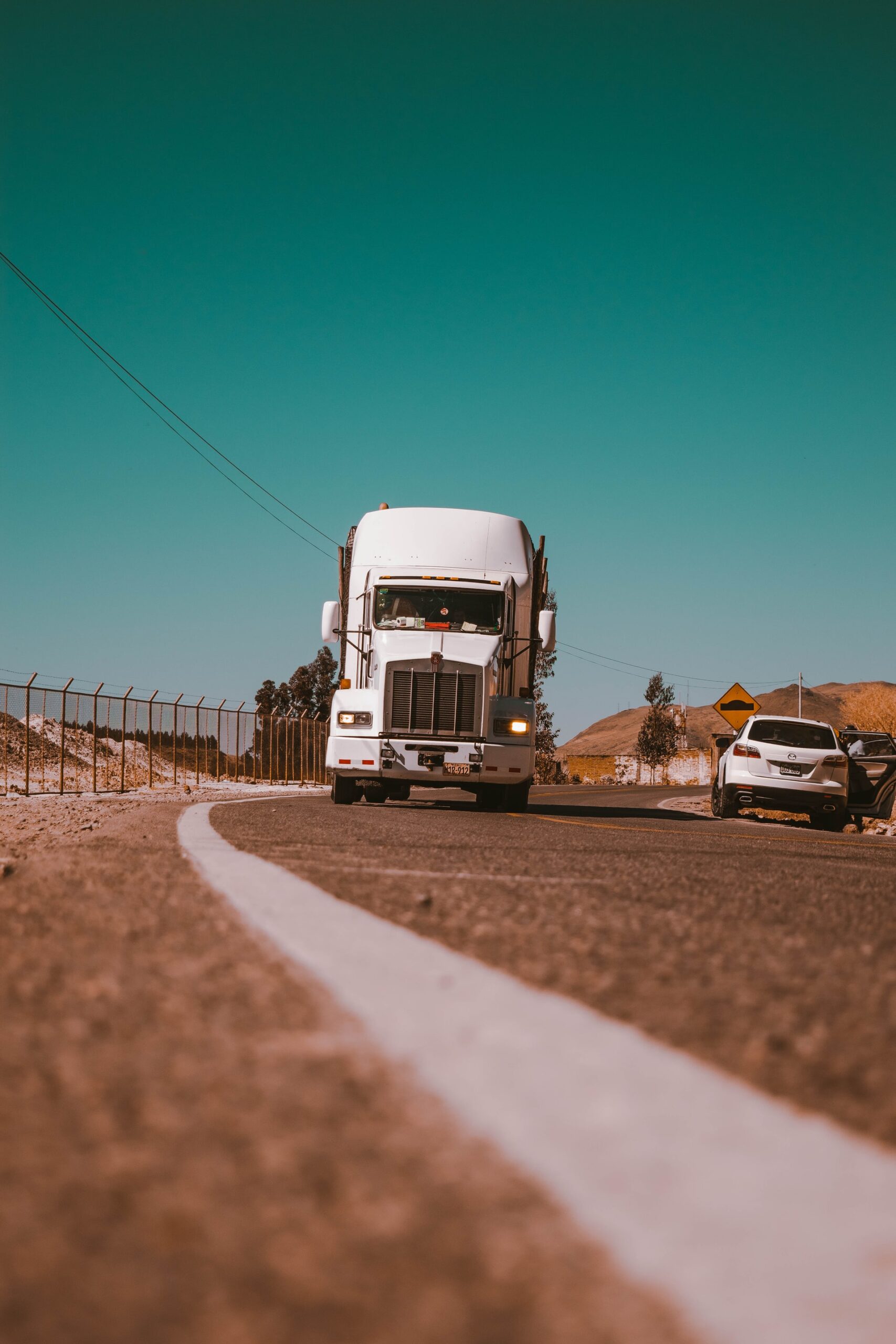
Nowadays we use roads to transport people or goods. The freight trucking industry in the U.S. generated a whopping $791.7 billion in 2019. There are multiple forms of freight trucking. For instance, trucking companies can focus on container transport, oil transportation, or retail freight. Retail is profitable in large numbers. Oil and chemicals are profitable because it's special transportation. The transporter needs permits and special equipment to contain the chemicals in a safe matter.
King Of The Road
In 2019, the largest road freight company in the world is FedEx Freight. FedEx is an American delivery service company based in Memphis, Tennessee. FedEx is known for its overnight shipping service and tracking system. Efficiency is the key to what makes a shipping business successful or not. FedEx has mastered the art of efficiency. They are always improving their business by innovations like robotics, but also by continuously tracking down bottlenecks and solve them.
Truck drivers were looked down on for a long time. However, nowadays we are in a gigantic shortage of truck drivers. Having your own road freight company can be highly profitable. There is more freight than ever before to be delivered. There are only 2 main barriers before you can enter this market. One is the financial side. A truck can cost easily $150,000 and this requires you to have quite the starting capital. The second reason is having the right papers. You can’t just buy a truck and start delivering. You need permits for the specific products you will be driving. Oil and chemicals will require you to have permits that are much harder to get than retail.
But if you can get it to work, rail freight can be a highly profitable business as the demand is ever rising.
Rail Freight
Rail freight has a very low carbon footprint compared to other forms of shipping. Furthermore, shipping your goods by train is far less expensive than by air or road. Especially for large amounts of goods rail freight can be highly profitable. As you can cut immensely on the transportation costs. However, there are a few things to consider.
- Rail freight shouldn’t be time-related. If your products have an expenditure date you are better off with other forms of transportation. Rail freight takes time before it arrives and with certain goods e.g. foods you simply don't have that time
- Rail freight is limited to the rail tracks. Meaning that you need another form of transportation for the final delivery
- Low ticket items are the best. Ideally, your products shouldn't be expensive. Rail freight can be rough and it has to endure a lot of vibrations. Commodities like coal, metals, or agricultural products are great for rail freight transport
- Rail freight in the U.S. is 2000 meters long. Canada exceeds that number with an average of 4000 meters. The trains are often managed by only 2 persons (1 being the driver). This makes rail freight extremely efficient and affordable.
- Transport by truck is 5 times more expensive than by rail

In 2019, Union Pacific Railroad reported a net income of $5.9 billion. 93% of the revenue came from freight transport. Union Pacific has a duopoly, together with BNSF Railway, on transcontinental freight rail lines in the west of the U.S. Railroad companies have been interesting for investors because they have a large defense around them. It's very hard, nearly impossible, to enter this market. This provides security for the business and more certainty in revenue.
Remember: this is no investment advice but merely for educational purposes. Always do your own research before investing in anything.


Air Freight
Airfreight transportation is the fastest way to ship goods over great distances. Airfreight demand is also growing rapidly and it’s expected it will continue to grow. Why? Because globalization and e-commerce are driving the air freight business to new heights. Pun intended.
We are consuming more and more high ticket items. These items are ideal for air freight. Often these goods are being produced in low-cost production countries like China. You basically have two options for freight transport: by air or by sea.
Airfreight is not very profitable compared to the passenger business. 20 tons of cargo is worth the same as 40 passengers with an economy pass. Clearly, it's way easier to transport 40 persons than 20 tons of cargo. That's why for a long time there was barely any interest in the air freight business. But things were about to change.
One of the biggest air freight transporters is DHL. DHL is part of the Deutsche Post and is the package delivery and mail service arm of its parent company. Interestingly enough the air freight sector got a huge impulse from express parcel carriers like UPS, FedEx, and DHL. E-commerce changed the game and these parcel services had to speed up their game. There was one more company joining the air freight space… Amazon. The king of e-commerce and the largest U.S. company.
The air freight business is very difficult to enter because it requires enormous amounts of capital. Furthermore, the regulations are very strict and the margins are thin. It requires big industry leaders like UPS, DHL, or Amazon to make these numbers work (economy of scale).
Sea Freight
Sea freight is of incredible value to our modern lives. As we told you in the introduction, 90% of all goods are being transported by sea. From iPads to grain, sea freight provides us with everything we need and desire. The international seaborne trade volume has been increasing with an average of 3.5% for years now. This is largely caused by the number of luxury products that we are ordering online.
The sea freight industry is often seen as one big industry but this is a common misconception. The sea freight industry is split into many niches and even sub-niches. There are freight companies that specialize in coal, but also those who specialize in LPG, or even broader carriers that focus on carrying retail goods. This makes the sea fright industry a very diverse industry with different profit margins. Often the more common a product is, the lower the margins. Special commodities require special transportation (Chemicals for instance) and these have often higher profit margins.

The Different Sea Vessels
You can recognize the niche diversity if you look at a couple of different types of ships:
- Bulk carriers
- Container ships
- Tankers
- Or multi-purpose
Bulk carriers: are cargo ships that are used to transport bulk items like coal, grain, or similar products. The products don't require a lot of preparation and can be easily stored together in large amounts, optimizing the full capacity of the carrier. The bulk carrier can be recognized by the large hatches on top of the deck. These open and make it possible to fill the bulk carriers fast.
Container ships: container ships carry their cargo within big metal boxes also known as containers. These containers are meant to carry dry cargo and are often combined with other sorts of transport e.g. truck transportation. These containers are ideal for multiple transportation types because they can easily be picked up and places on the back of a truck or train wagon.
Tankers: the main purpose of tanks is to transport fluids. You can think of fluids like oil, petrol, LPG, LNG, chemicals, but also food products like wine! The tanker sector is good for one-third of the freight of the world. Tankers are rare and in high demand despite the recent drop in the oil price. Making this one of the most lucrative niches.
Multi-purpose ships: these are a hybrid version between bulk and container. You can store both commodities and the more standard cargo from container ships. The multi-purpose approach gives these ships a lot of flexibility and is often used to combine loads.
Sea freight has been crucial for our existence and it will continue to do so for a long time. The ships might change (see the chapter: Sustainable Ships Ahoy!) but their task and value will not depreciate. Entering the sea fright business is difficult due to strict regulation, but more importantly, because of the gigantic starting capital requires to own or lease ships. It can also be highly profitable as the industry is closely linked to our economic growth.

An Industry With A Moat Around It
Industries with moats around them are, as Warren Buffett describes it, industries that are difficult to enter. They have an advantage by already being active within the sector that has a natural defense around it. Therefore they will have less competition and most of the time share the profit with only a handful of competitors. Moats can be for instance licensing or high starting capital requirements.
We are going to look at the two biggest moats around the shipping industry:
- Licensing
- Insurance
Licensing
Shipping companies are bound to laws and regulations to make sure that all the shipping activities are legal and safe. This goes for both domestic and international freights. However, there are different licenses required to ship internationally than it is for domestic transport. The longer the journey, with more stops, the more complicated the licensing becomes.
If you want to export goods to foreign counties, you will need an international export license. This license will make the shipping owner responsible for the cargo at all times. It will become your responsibility to have the right licensing in place. If you don't comply with these requirements you can expect large financial penalties from $50,000 or higher depending on the type of violation.
Insurance
Insurance is the second moat around the shipping industry. The protection of cargo is the most common and also expensive insurance for shipping companies. Road transport is relatively affordable if you compare this with the cargo insurance of oil tankers or container ships.
Shipping companies have two main types of insurances. The first is to insure their equipment, vehicles, planes, or vessels. You can imagine that the damage to an airplane's engine by a bird can cost a lot. But it could be even worse. What if an oil tanker gets damaged and leaks oil into the ocean? Large cargo means a large responsibility.
The second insurance is to cover the loss of cargo. Most insurances will cover against the loss of cargo when it’s an actual total loss or a constructive total loss. The difference being that an actual loss means that the product is beyond reparation or that it's more expensive to repair than the product is worth. A constructive loss occurs when the product is damaged but can be repaired. You will be compensated for the repair costs in this case.
There are large sums of money involved in the insurance of the shipping industry. This makes it more difficult to enter the market, but it also adds a layer of protection. There is less competition and this means that you have the potential of having more market share.
The Shipping Industry King Of Kings
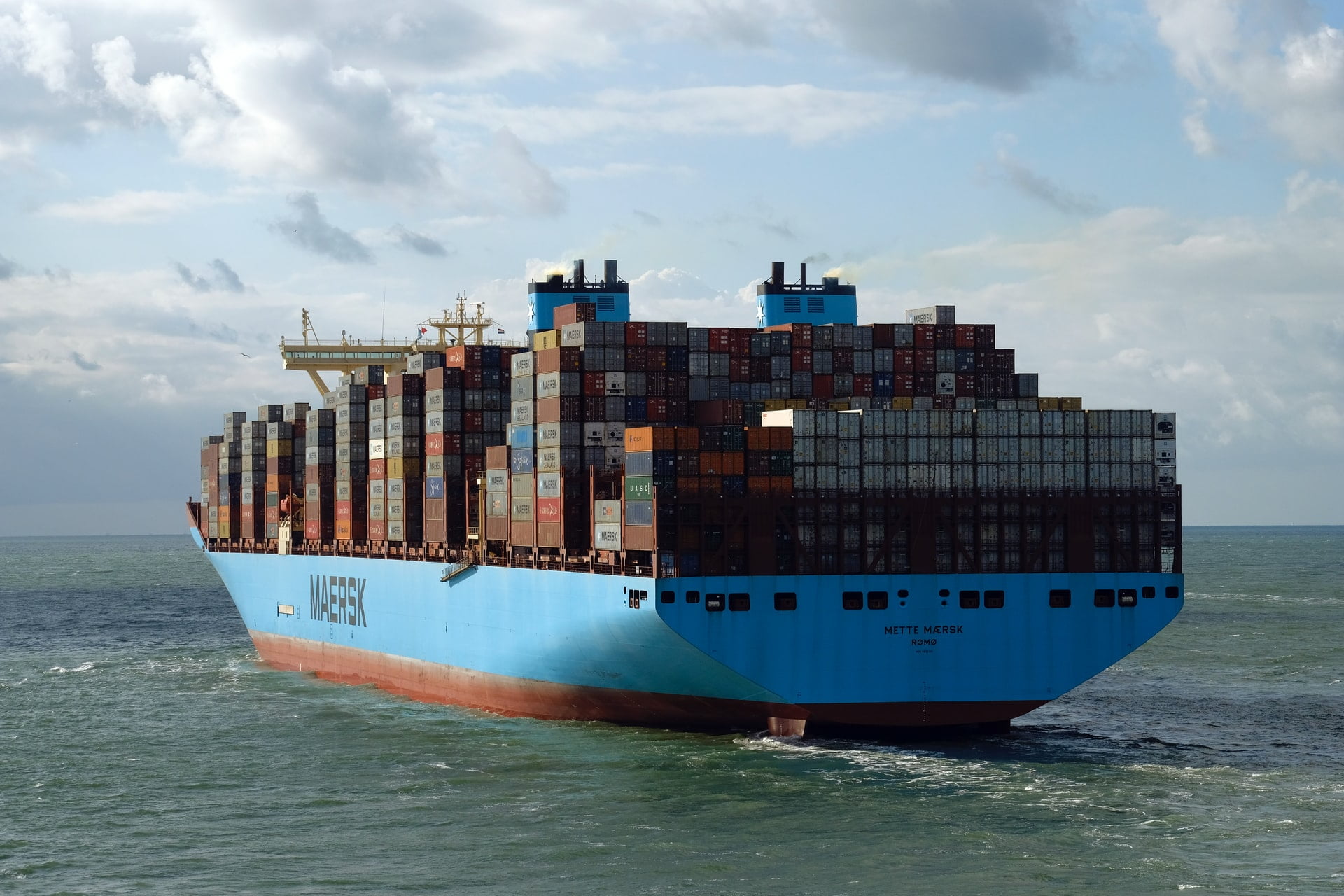
The biggest shipping industry King by sea is by far APM-Maersk. Since 1996, Maersk has been the largest container shipping line in the world. With 84,000 employees, Maersk generates $39 billion in revenue in 2019. Maersk was founded in 1904 by Peter Maersk Møller. The emblem comes from the Christian roots of Peter Maersk Møller. The small seven-pointed star is a remembrance of the night that Peter prayed for a sign that his wife would recover from illness. He received the sign that night.
Maersk is divided into two main business segments:
- Transports & logistics
- Energy
Transport & logistics: this is by far the main business segment of Maersk both by revenue and staff. This includes a large number of vessels that operate in multiple sub-niches within the shipping industry. Furthermore, Maersk owns a large number of ports, terminals, and inland service networks. Maersk has an interest in 57 ports and container terminals in different regions of the world. This includes: Europe, North America, Latin America, Middle East, Asia, Africa, and more.
Energy: to diversify their earnings Maersk started to establish an energy unit. The energy unit started by mainly focusing on oil and gas exploration in the North Sea close to Denmark. Nowadays they have expanded their exploration fields to Northern Europe, but also in countries like Qatar.
The Largest Ship In The Shipping Industry
They also own the largest container ship in the world. These E-Class vessels are engineering masterpieces. Incredible efficient and also with a look at the future. Maersk is testing to use algae biofuel to power their container ships. Maersk is continuously looking to innovate the shipping industry and to lower its carbon footprint. Below you will find a video of Richard Hammond who talks about one of the E-class vessels from 2006, the Emma Maersk. Worth a watch!
Jack Sparrow Is Coming For The Treasure…
Most of us have played 'pirate' in our youth or have seen the legendary Pirates of the Caribbean movies. Unfortunately, these classy pirates are good for stories but aren't the ones that roam the seas. Especially in the Gulf of Aden, close to Somalia, pirate attacks are a real threat to merchant ships. They carry these attacks out with a combination of speed and brute force.
These are the most favorable targets of pirates (stats by Statista):
- Bulk carriers: 46 times attacked in 2019
- Product tanker: 38 times attacked in 2019
- Tankers: 19 times attacked in 2019

Now you might wonder why container ships are getting attacked less, after all, they carry a lot of valuable goods. It all has to do with speed. The container ships are a lot faster than bulk carriers or tankers. This makes them difficult to attack and with more risk while entering the ship. On the other hand, it’s quite a scary thought if you think about these gigantic oil tankers being in the hands of pirates. The threat that possesses to our climate… Truly scary.
The Attack Plan
As we've told you in the introduction, the pirates make use of speed and brutal force to conquer the merchant's vessels. Our modern ships are heavily innovated, automatized, and optimized so it can be managed by a small crew. This is efficient and will increase profits. The downside is that you really can't put up much a fight with pirates. The pirates are floating around in their motherships (hijacked vessels) and have little high-speed boats to attack with. The tactic is simple. Make use of the high-speed boats to get close, and shoot with machine guns and rockets (RPG’s) at the ship’s bridge.
When the vessels are hijacked, the crew and cargo will be held hostage by the pirates. If you want your vessel and crew back safely, you will pay the pirates a large ransom. The economic damage from these pirate attacks is enormous. Although different navies have addressed the problem, there still is a piracy problem. There needs to be a more thorough approach including multiple nations to put a hold on the pirates.
There are 2 possible solutions to reduce the damage of these pirates.
Private Armies
One of the solutions that different shipping companies are using is the use of private armies. These private companies hire often ex-navy seals or other highly skilled individuals. They will be joining the vessel during their sea journey and guard it with heavy weaponry. When the pirates approach the vessel they will first warn them and fight them if they have to. Most private companies are highly organized and skilled so there are no unnecessary gunfights.
Governments Must Act
The World Shipping Council has initiated the “Save our Seafarers” campaign. The goal of this campaign is to activate governments to act on the piracy issue. The World Shipping Council is asking for the following:
- Decrease the effectiveness of the easy recognizable pirate mother ships
- Give naval forces the authority to arrest and detain pirates so they can be prosecuted for their crimes
- Criminalize all the acts of piracy under national law and work together to reduce piracy through international conventions
- Increase the naval presence
- Provide more protection and support for the sea shipping industry
- Trace and punish the brains and financiers behind these criminal (pirate) syndicates
If governments can increase the level of cooperation on an international level, we have a chance to greatly reduce the piracy threat. The sea freight industry has a great responsibility for the economic welfare of our nations. An attack on these vessels is like an attack on our economy. They hurt us all and need to be stopped permanently.

Sustainable Ships Ahoy!
Shipping is responsible for around 2% of the world’s co2 emissions. It’s not one of the most polluting industries if you compare it to others, but the shipping industry is taking its responsibility nonetheless. After all, we should try to reduce our carbon footprint wherever we can!
The industry leader is setting the right example. Maersk came up with an emission reduction plan to bring their emission back to 42% by 2020, 60% in 2030, and 100% in 2050. This is quite a challenge for an industry that hasn't always been the cleanest boy in the room. To power the large engines of container ships, the companies used the dirtiest kind of fuel. It was literally from the bottom of the barrel. Which made it very cheap but incredibly dirty.
But how do they want to do that? Efficiency is the key.

Short-Term Emission Solutions
For now, the fastest way to reduce emissions is by optimizing the structure of the ships. The ships pollute the most when they are using a lot of speed. Reducing the speed will bring back pollution. However, the ships were never built for this low-speed. The bulbous bow is constructed to reduce drag and thus increase speed and fuel efficiency. But after lowering the average speed of the ships, the old bulbous bows stopped working to their maximum potential. The industry is working hard to replace their old bows with a modern one that is designed for these lower speeds.
Long-Term Emission Solutions
For the long-term, there are more drastic measures necessary. Wind energy could be used as a secondary power source but never as the main one. These gigantic ships just use too much power to be able to move. Some companies have switched over to liquidized gas because it pollutes less. Unfortunately, that really isn't a solution at all. Gas is still a fossil fuel and will heat our planet. Norway and Japan are betting on hydrogen. The main challenge with hydrogen is the fact that it remains to be very expensive. Furthermore, it will take up more fuel space which could have been used for cargo.
The change in fuel and making it renewable will hurt the economic profitability of the sea freight industry. It's going to take a lot of investments and willingness to cut profits to get ships powered by renewable energy. The sea freight industry will continue to be absolutely crucial to our existence for decades to come. That's why it's the smart move to invest in these new sources now. The future needs it.
E-Commerce Provides Continued Growth
E-commerce and globalization have driven the shipping industry over the last years to new heights. We are making more use of shipping than ever before. The whole COVID situation came from nowhere and has changed the way we do our shopping permanently. A lot of people (often older folk) preferred to do their shopping in bricks and mortar stores. But because COVID was such a big threat to them a part of this group transitioned to online shopping.
E-Commerce And The Shipping Industry
This created a huge responsibility and stress on the backs of the shipping companies. Not only because of the immense increase in demand but also because of all the different policies and closings of borders by different countries. There were ports in lockdown, ships in lockdown, and a lot of employees that became sick or in quarantine. Some shipping companies flourished where others saw their profitability go up in smoke. Amazon did great but the maritime trade did horrific as shown below.
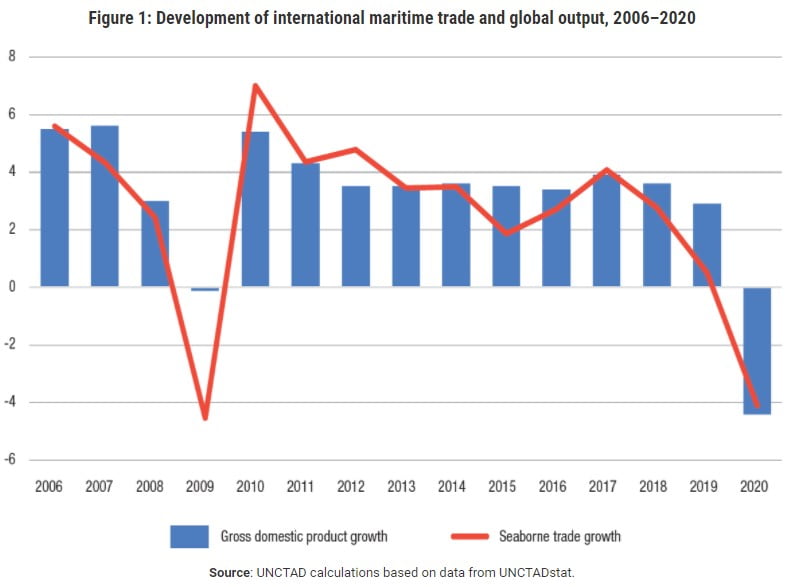
For the first time in 12 years, the maritime trade declined. We are most likely to suffer economically from the pandemic on a greater scale. International maritime trade has always been a great thermometer to measure the worldwide economy. However, we should focus on rebuilding and looking towards the future.
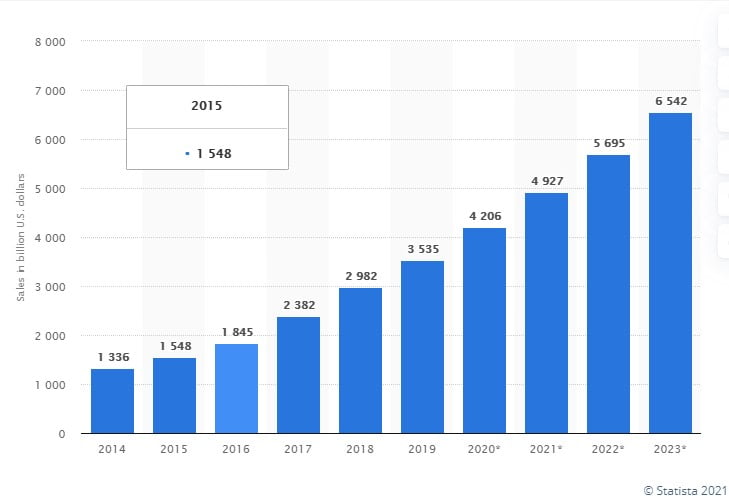
E-commerce is expected to keep growing at a rapid pace. This means there will be more shipping challenges to be solved in the near future. The demand is rising but the shipping industry is suffering from COVID restrictions like lockdowns. Furthermore, the demand is rising so fast that delivery companies like UPS and DHL are pushing their employees to the limit because of all the extra deliveries.
We need more innovation within the shipping industry to tackle this problem. One of the possible solutions is coming up in the next chapter: Drones Can Potentially Change EVERYTHING!
Drones Can Potentially Change EVERYTHING
Shipping has innovated itself by increasing its efficiency. This meant that there are fewer people involved in the transportation of cargo than there was before. Just think about the stories of these huge trading companies years ago. They had around 200 crew members to manage and defend the ship. Nowadays a container ship has a crew of 20 people.
The next revolution within shipping? In the future, there is possibly no crew involved in the shipping of our goods. This goes for road, rail, air, and sea freight. Companies are working hard to create unmanned vehicles and make them autonomous. This means the vehicles can fully control their own affairs without humans interfering. We simply tell them where to go.
Companies like Volvo and Daimler are working hard to create autonomous trucking vehicles. But there are also disruptors necessary for smaller deliveries. That's the part we are going to focus on in this last chapter. How can we receive our packages faster and can we lower the stress on the parcel couriers? The answer is drones.
Drones Will Solve These Issues…
Drones have the potential to solve the problems we are facing within shipping. We can reduce the delivery time further, and also relieve the employees from the crushing work pace that is necessary to keep up with demand. These drones will be completely autonomous and made to travel long distances.
There can be thought of different drones for different tasks. There will be a smaller drone that has the capability to deliver one package to consumers. Amazon has been busy with this for quite a while. It’s called Prime Air and when this comes off the ground (pun intended again) it will revolutionize shipping beyond your dreams. Packages will arrive much sooner and we can start to think about delivery times of hours instead of 1 day or more.
The Shipping Industry Dream...
However, that's not the only niche we can revolutionize with drones. No, we can also scale things up quite a bit and start to compete with airplanes. Right now drones are traveling to the smaller parts of the Bahamas (where no plane can land) to deliver goods. These drones are like autonomous planes and they can carry quite a bit of cargo. Some drones are even equipped with landing gear for water. This is especially useful for islands that don't have a landing strip but are often surrounded by water.

Companies like Natilus are working hard towards solutions and are showing great promises for the future. They claim to reduce air freight costs by 50% through the use of autonomous drones. Some companies focus on the improvement of health care like Matternet. They want to make use of drones to deliver blood work samples and results faster than traditional transportation.
Drones Are Using Renewable Energy
Drone developers are busy with creating drones powered by electricity. These drones will have no carbon footprint and are therefore better for our climate. For short flights, this is a relatively easy task to perform, but you can imagine the challenges long-distance drones face. Long-distance drones will have to overcome ocean winds, the limitations of batteries, and transportation costs, to be viable. Personally, I think that it's only a matter of time because many drone companies are showing impressive results, and they aren't slowing down anytime soon.
Why Isn’t It Here Yet? [Shipping Industry Challenge]
We have been hearing about drones for years now, but why are they not here yet? The simple answer is regulations. The regulations are very strict and that's putting a hold on the full potential of the drone industry. But to be fair the regulations and restrictions are making sense at this moment. The increase in autonomous drones has been causing a lot of extra air travel. These can interfere with air traffic and are therefore dangerous. There needs to be a better and more clear regulation to empower the drone industry, and at the same time, to keep everyone safe.